What to inspect on used stirrup leathers
Look at both straps together, particularly the buckle attachments and adjustment holes, and treat uncertain strength as a reason to seek advice.
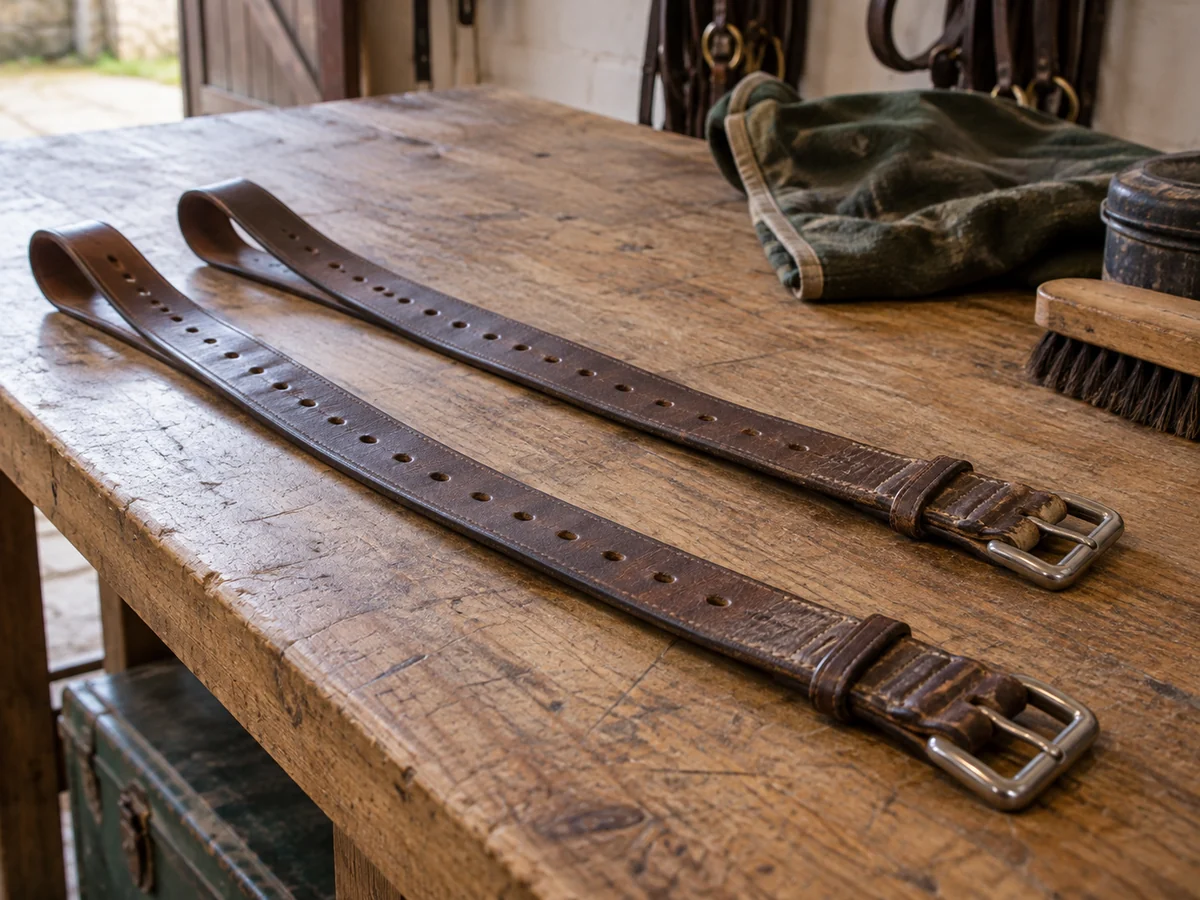
Compare the pair before the price
Ask the seller to lay both stirrup leathers flat beside each other without stretching them. This makes differences in length, hole position and construction easier to see. A pair can carry matching size stamps while having changed differently in use. A photograph of them hanging folded over a rail hides much of the information that matters.
Confirm the make, model and original length, and ask whether they were bought as a pair. Some designs contain reinforcement that is not obvious from the outer surface. Knowing the construction helps you find the right care instructions, but it does not let you judge hidden condition from a photograph. Ask the manufacturer or a saddler if the identity or suitability is uncertain.
Look closely around the buckle, stitching and holes used most often. Request pictures of the edges and reverse side, not just the smooth outer face. Elongated holes, splitting, exposed layers or loose stitching deserve attention. Do not try to demonstrate strength by hanging weights from the straps or pulling hard; an improvised test cannot certify them and may cause further damage.
Ask about added holes, shortening and repairs. A neat-looking alteration still needs to be appropriate for the material and construction. If a seller says a repair was professional, ask who did it and what was repaired. The answer helps you decide what further assessment is needed; it is not a reason to stop looking at the actual pair.
Consider the cost of uncertainty
Used leathers may offer only a small saving once postage and assessment are included. Compare that saving with the cost of a compatible new pair from an identifiable source. There is no advantage in acquiring straps that you do not feel able to use and must replace immediately. If their strength or history remains doubtful, choose another option rather than treating the first ride as a trial of condition.
If they are assessed as suitable, check their length and compatibility with the saddle and stirrups before use. The correct condition does not guarantee a useful adjustment range. Save the product details and inspect them as part of the normal tack routine, paying attention to both sides. Replacing one damaged strap with an unrelated spare can introduce a new mismatch, so ask for advice about an appropriate pair when replacement is needed.
Reading & references