Equipment for tying up at the yard
A safe tying arrangement depends on the place, the equipment and a procedure someone has taught you.
Ask for a demonstration at your yard
Tying a horse is a handling skill, not just a knot. Begin with a competent person who knows the horse and the yard's arrangement. They can show you the appropriate position, equipment and release procedure. A written description cannot establish whether a particular wall fitting, horse or length of rope is suitable in the situation in front of you.
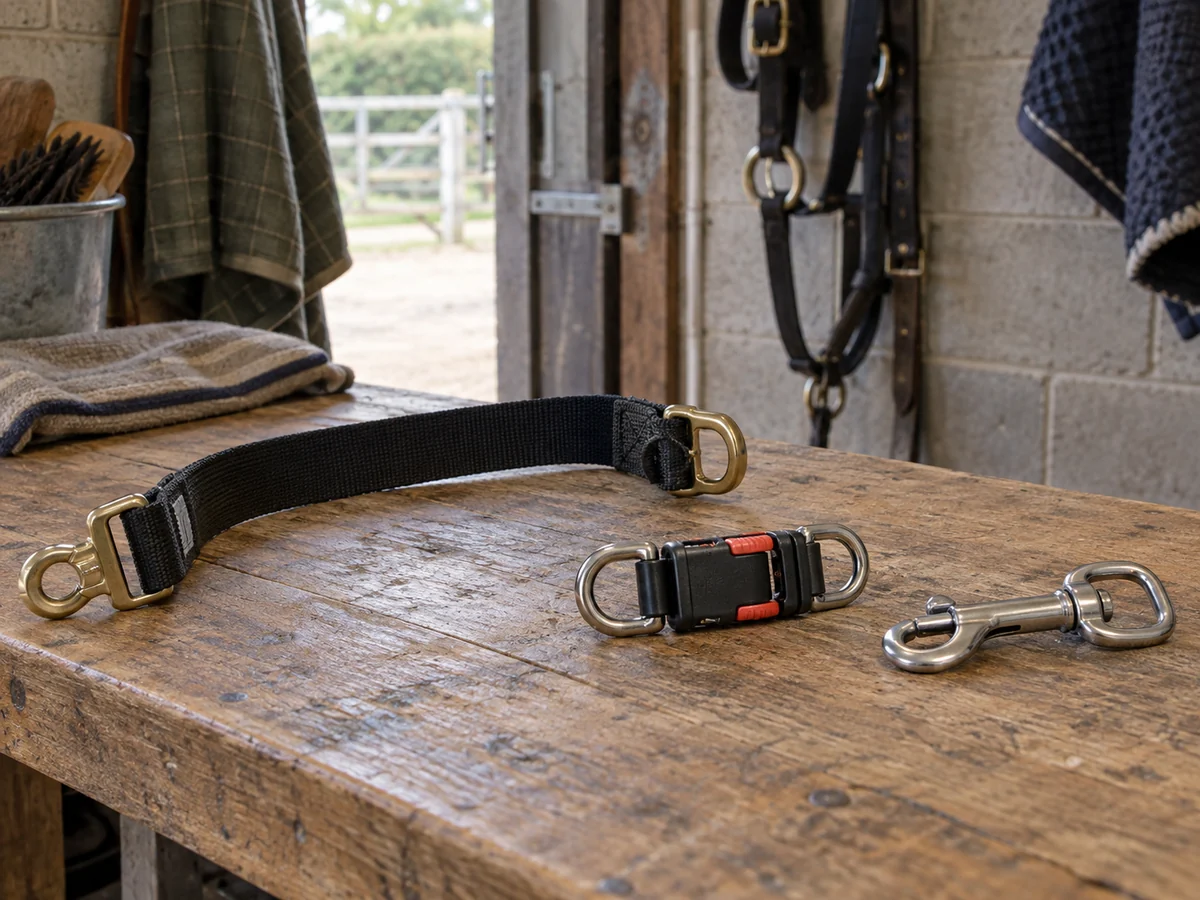
The British Horse Society advises using a breakaway point when tying in its transport guidance. At the yard, discuss how that principle is provided in the specific system. Purpose-made devices have their own directions and limits. Do not assume that any old loop of string has predictable strength or that adding several loops makes the arrangement safer.
Check the route of the rope
Use an appropriate headcollar and lead rope, never reins or the bit as the tying connection. The rope should be arranged as taught, with sufficient room for normal positioning but without creating a hazardous loop. A horse that can step over or become caught in spare rope is not made secure by a tighter knot elsewhere.
The tie point and surrounding space need inspection too. Loose fittings, projecting objects, slippery ground and nearby equipment can change the risk. A convenient gate or rail may not be designed for the load. Ask the yard manager before using an unfamiliar place, particularly if other horses, vehicles or people pass close behind it.
Know how the arrangement comes apart
Practise the release method without a horse until it is understood, then learn under supervision with suitable equipment. Do not thread, wrap or lock the rope in an extra way that defeats the intended release. If a manufactured system is used, everyone handling the horse should know its instructions and where replacement components come from.
A horse that pulls back or becomes distressed needs a considered handling plan. Repeatedly replacing the weak point with something stronger can transfer force to the horse or structure. Seek experienced help and appropriate professional advice. Keep tied horses under suitable supervision, and inspect the equipment after any incident before reusing it. A bent clip, damaged headcollar or partly failed fitting belongs out of use until assessed, even when it appears able to hold again.
Reading & references