How stirrup leathers are put together
The name includes several constructions, from traditional folded leather to reinforced and single-strap designs.
Follow the load-bearing route
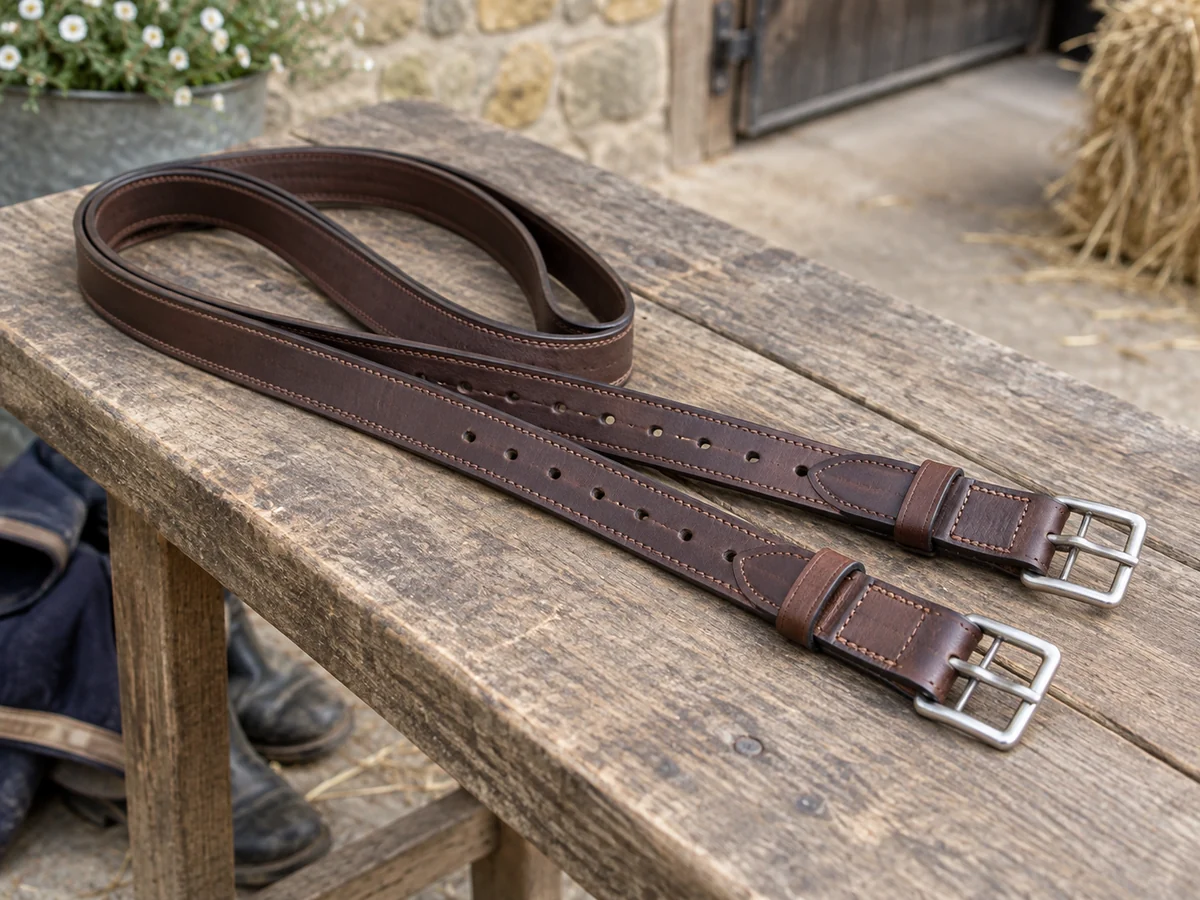
Traditional stirrup leathers are adjustable straps that connect the iron to the saddle's stirrup bar. The strap commonly passes through the iron and returns to a buckle, creating a loop. Other designs use different connections or a single strap against the leg. Before replacing a pair, identify the system already fitted and check what the saddle manufacturer permits.
Some leathers contain a reinforcing core. Others are made from synthetic materials or use specialised fittings at the iron. You cannot reliably identify the whole construction from the outside colour. Product details should explain the material, width, length and intended connection. A slim appearance may refer to the section beside the rider rather than the size of the buckle under the skirt.
Holes and buckles deserve a close look
Adjustment holes should retain a sound shape without tearing into one another. The buckle tongue needs to sit properly, and stitching around the folded end should be intact. Take the strap off for a full inspection when cleaning, following the saddle's instructions. Damage can hide in the part normally folded through the iron or tucked away beneath the skirt.
Do not add holes close together to solve an unsuitable length or trim an unfamiliar reinforced strap at home. Alterations may affect its construction or leave insufficient material around a fastening. A saddler can advise whether a conventional leather is suitable for an adjustment; the answer is not automatically the same for a covered webbing or synthetic design.
Equal numbers are not always equal lengths
A matching hole number is convenient, but it does not prove that a used pair is still equal. Compare the complete straps as the maker recommends and ask an instructor to check the rider's arrangement. Stretch, replacement parts and different starting lengths can make apparently matching numbers misleading. Never try to correct a rider's asymmetry by changing holes without understanding the cause.
Store the leathers without forcing sharp new folds, and keep the two sides together if they are a matched pair. When they are removed for saddle work, record which components belong to the set. A spare found on another rack may have a different width or fastening even when it fits through the iron. Compatibility is worth checking before it is needed during a hurried lesson change.
Reading & references