Choose a saddle rack that supports the saddle
A rack should support the saddle appropriately and leave room to lift it without scraping nearby fittings or equipment.
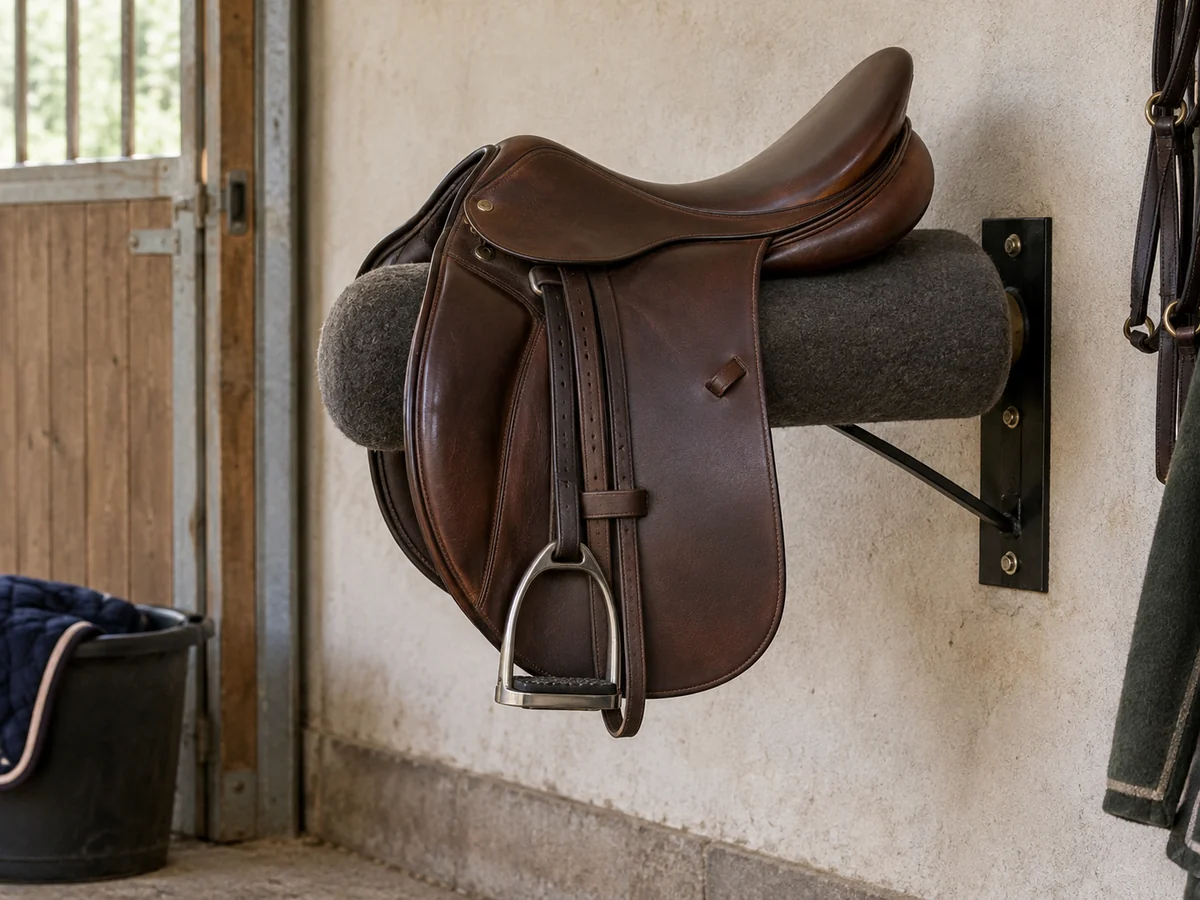
Start with the saddle's requirements
A saddle rack is more than somewhere to hang a valuable item. Its shape and contact points need to suit the saddle it will support. Ask the saddle manufacturer or fitter for storage guidance before choosing a narrow pole, shaped rack or freestanding stand. Do not assume every rack sold for saddles supports every panel construction equally well.
Look at the way the saddle rests when placed normally on the proposed support. It should not need to be wedged, balanced or forced into position. Ask for advice if a rail presses into an area the maker says should remain unsupported or if the saddle rocks awkwardly. Adding random padding can conceal the contact points without necessarily producing a suitable support.
Allow a comfortable lift
Position the rack so the saddle can be lifted and replaced without twisting around a door or reaching over another saddle. Measure the clearance with the saddle's full outline in mind, including flaps and any cover. A rack that fits neatly into a narrow corner may still be awkward for the person carrying the equipment.
Check the rack's load rating and installation instructions. Wall material and fixings matter, so have the rack fitted by someone competent for the job. For a freestanding design, consider stability and the floor beneath it. Avoid placing it where a passing person, opening door or trailing strap can easily knock it. Do not use a tack-room rack as an improvised mounting or seating aid.
Keep the surrounding space useful
Provide a separate place for damp pads rather than trapping them beneath a stored saddle. Remove loose dirt and follow the saddle's care instructions before putting it away. LeMieux's general saddlery guidance emphasises clean, dry storage; the exact treatment still depends on the maker and material. Storage cannot compensate for leaving equipment wet or dirty after use.
Inspect the rack and its fixings periodically for movement, sharp edges or damage to a covering. Look at the saddle's contact areas too, and ask the fitter about any concern rather than dismissing a developing mark. If the room is rearranged, reassess the lifting space and support instead of moving the rack into whichever gap remains. A suitable rack makes storage straightforward while respecting the saddle's construction and the user's ability to handle it comfortably.