Straight, shaped and anatomical girths
Curves and cutaways describe a design; their position on an individual horse determines whether they are useful.
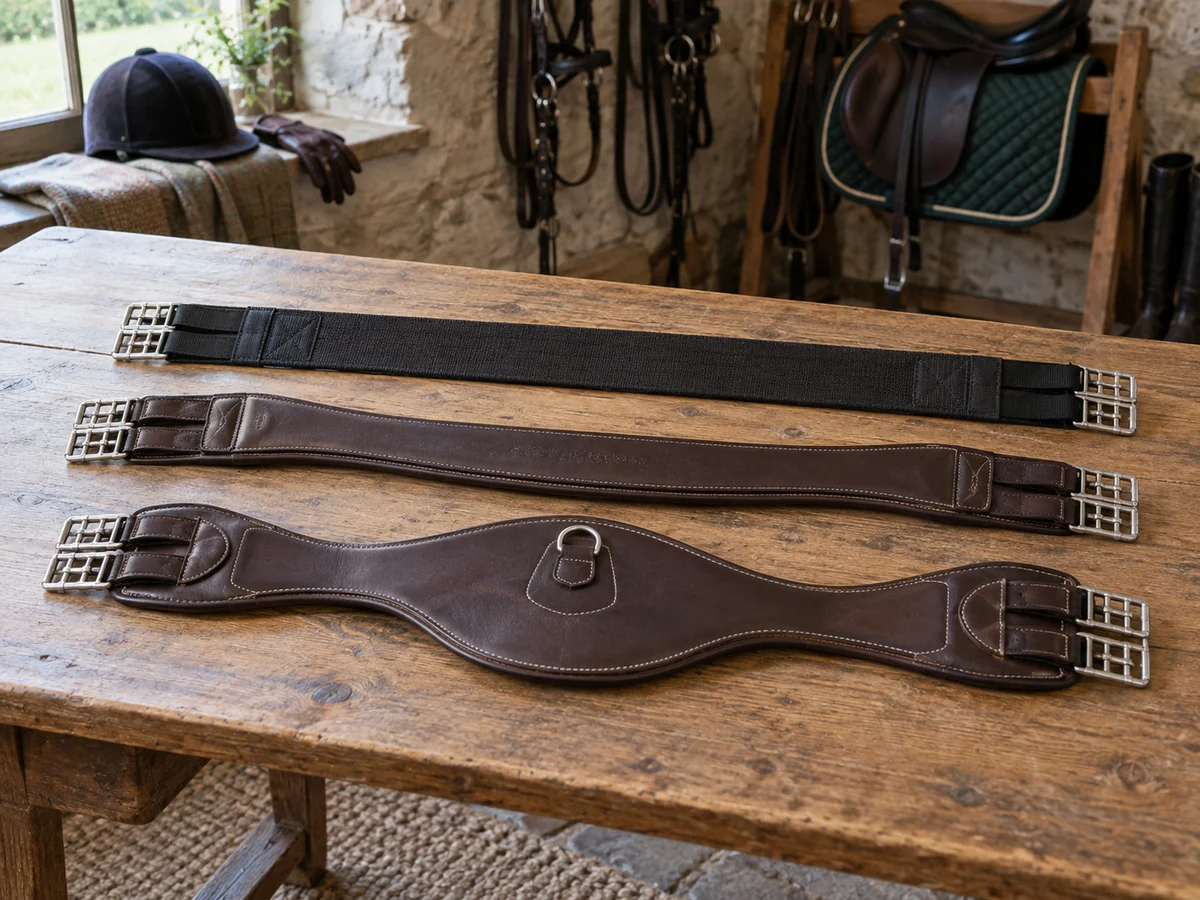
Read the outline carefully
A straight girth has a broadly consistent line between its ends. A shaped girth may narrow around the elbow area or curve along its length, while 'anatomical' is a description used for many different designs. These terms do not guarantee a particular fit. Two anatomical girths can have different curves, central widths and buckle arrangements despite sharing the same marketing word.
Place a girth flat and identify which edge and surface face which direction. Some designs are directional. A curve that looks symmetrical at first glance may not be, particularly when viewed alongside the manufacturer's fitting illustration. If the label is missing or the orientation is unclear, ask the maker or a saddle fitter rather than copying another model's arrangement.
Consider where the saddle and girth meet
The horse's girth area and the saddle's girth strap position work together. A shaped girth is sometimes selected to accommodate that relationship, but it cannot be judged from the girth alone. Movement, pressure and the horse's comfort all need considering. Do not attempt to pull a poorly positioned saddle into place by progressively tightening a different girth.
Check the ends as carefully as the middle. Buckle bulk, guards, elastic sections and strap length affect the arrangement beside the horse. The same measured girth length can produce a different result when the buckle design changes. When discussing a replacement, take the current girth and photographs of the complete saddle arrangement, but expect the fitter to assess it in person where needed.
The daily checks are quite ordinary
Before use, feel the clean underside for dried sweat, grit, distorted padding or hard edges. Look at stitching around buckles and any elastic for damage or uneven deterioration. A soft-looking cover can conceal the condition of the girth beneath, so remove detachable covers for inspection and cleaning as the maker directs.
After riding, note any fresh rubbing, swelling, tenderness or unusual resistance during girthing and seek appropriate advice. Simply buying a wider or more expensive shape is not a diagnosis. Keep the product name and fitting instructions, including orientation, with your equipment notes. That makes it easier to discuss the exact model later instead of trying to reconstruct which version of an anatomical girth you bought.
Reading & references