Finding the right starting point for girth length
Measure according to the girth maker, then assess where the buckles and shaped sections sit in the complete setup.
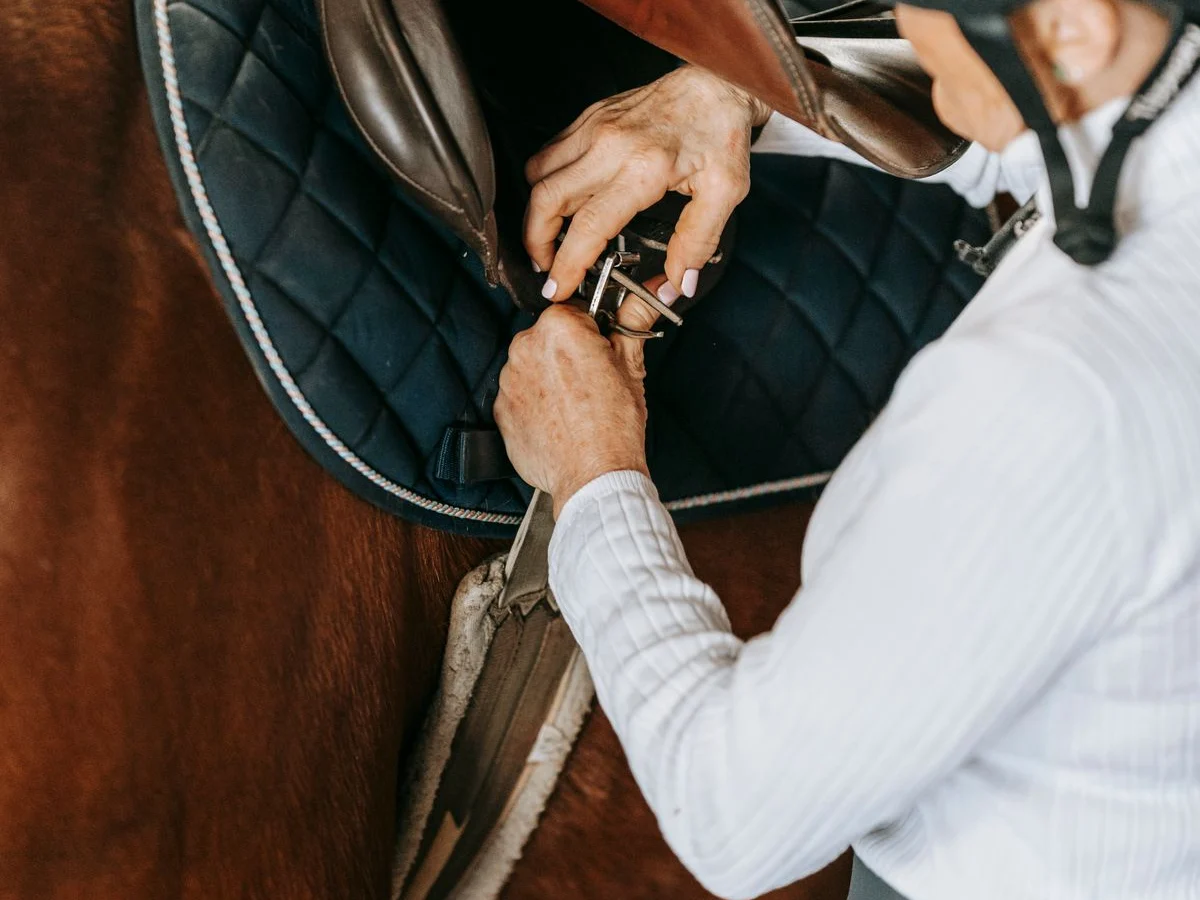
Begin with the saddle being used
The saddle's girth straps determine the kind of girth you are looking for. A long girth used with short straps cannot be replaced by a short dressage girth simply by choosing a familiar number. Start with the actual saddle and ask your fitter which type and approximate length should be considered. Have the usual pad ready too, so the discussion concerns the arrangement you intend to ride in.
If the current girth fits well, note its maker, model and measurement as a useful reference. If it rubs, sits awkwardly or leaves little adjustment, do not reproduce its length automatically. Describe where the problem occurs. A measurement from equipment that was never suitable is a record of the old problem rather than a reliable shopping target.
Check the measuring convention
Read the new manufacturer's size guide before using the tape. Stübben, for example, describes its girth length from buckle end to buckle end. Other descriptions may need clarification, especially when elastic, covers or unusual fittings are involved. Ask the seller to show the starting and finishing points in a photograph if the specification is unclear.
Use the same units for the comparison and note whether an elastic section is relaxed. Do not pull a used girth hard to make it reach a catalogue length. Record the unstretched measurement and any obvious asymmetry instead. A stretched elastic section may be a condition issue, not evidence that you have found a conveniently larger size.
Length is not the whole fit
The buckles, padding and shaped sections need to lie in appropriate places on the individual horse. A girth can fasten successfully while its edges or hardware sit poorly. Ask the fitter to assess this with the saddle, rather than treating the fact that both buckles reach the straps as sufficient. Tightening further is not a way to correct an unsuitable shape.
Before ordering, confirm what the retailer allows for a clean fitting check and keep the packaging until the decision is made. Follow the maker's fitting instructions and arrange help if you are uncertain. Once a girth is selected, record the model and length so that a future purchase starts with useful details. Revisit the fit when the horse or saddle changes instead of assuming the same length will always remain appropriate.
Reading & references