Understanding a breastplate's job
A breastplate is intended to help limit backward saddle movement, but the saddle still needs its own fitting assessment.
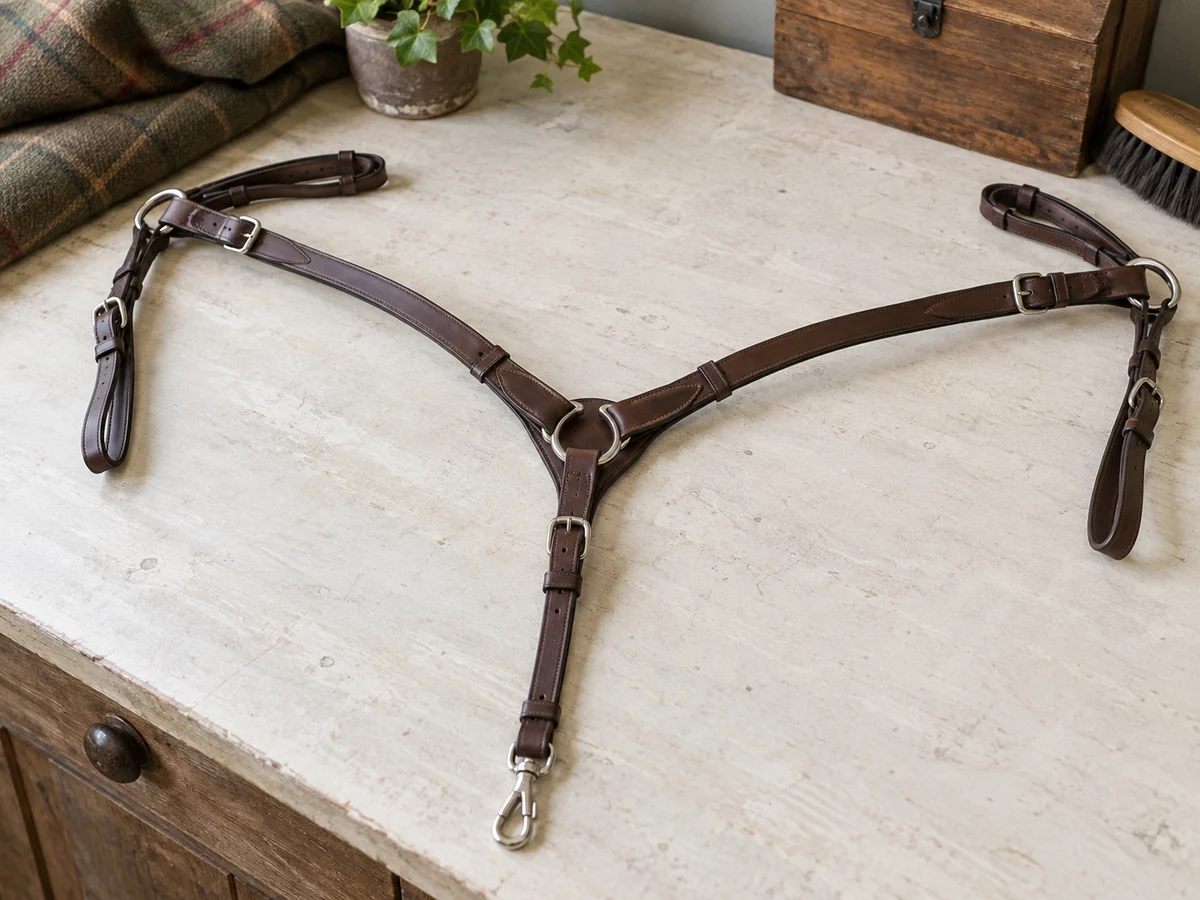
Notice the attachment pattern
A breastplate connects around the front of the horse and to parts of the saddle or girth according to its design. Three-point and five-point descriptions refer to different arrangements of connections. Elastic inserts, padding and detachable attachments also vary. Trace each strap using the manufacturer's illustration before attempting to fit an unfamiliar model.
Its intended job commonly includes helping prevent the saddle from sliding backwards. That does not mean it can rescue a saddle that is the wrong shape or size. If a saddle has started moving differently, involve the saddle fitter and consider changes in the horse, girth or pad. Tightening a breastplate until movement stops may introduce restriction without addressing the cause.
Movement matters
The horse needs freedom around the shoulder and chest. Check the breastplate with professional help through the work for which it will be used, rather than judging only a still photograph. Elastic can accommodate movement, but its presence does not make an over-tight arrangement acceptable. A strap stretched close to its limit before work has little useful range remaining.
The connections must be appropriate for the saddle. Not every small ring is intended to carry the same load, and not every girth attachment accepts every clip. Consult the saddle and breastplate instructions or ask the fitter. Improvised fastening to a convenient-looking ring can be a poor substitute for the attachment the equipment was designed to use.
Keep the functions distinct
A detachable running martingale fork adds another component with its own fitting requirements. Ask whether it is needed and how its rings and rein stops should be arranged. Removing or adding the fork should not be done without understanding the complete setup. A breastplate sold with an accessory is not a recommendation that every horse use that accessory.
Before each ride, inspect stitching around junctions and the condition of clips, buckles and elastic. Clean the underside where sweat and grit collect, and check for fresh rubbing after use. If a clip no longer closes positively or elastic has become uneven, arrange repair or replacement advice. Store the breastplate so the straps remain easy to identify; a twisted junction is much easier to miss when equipment is collected in a hurry.
Reading & references