Loose rings, fixed cheeks and their differences
The sides of a bit are separate from its mouthpiece, and both belong in any fitting discussion.
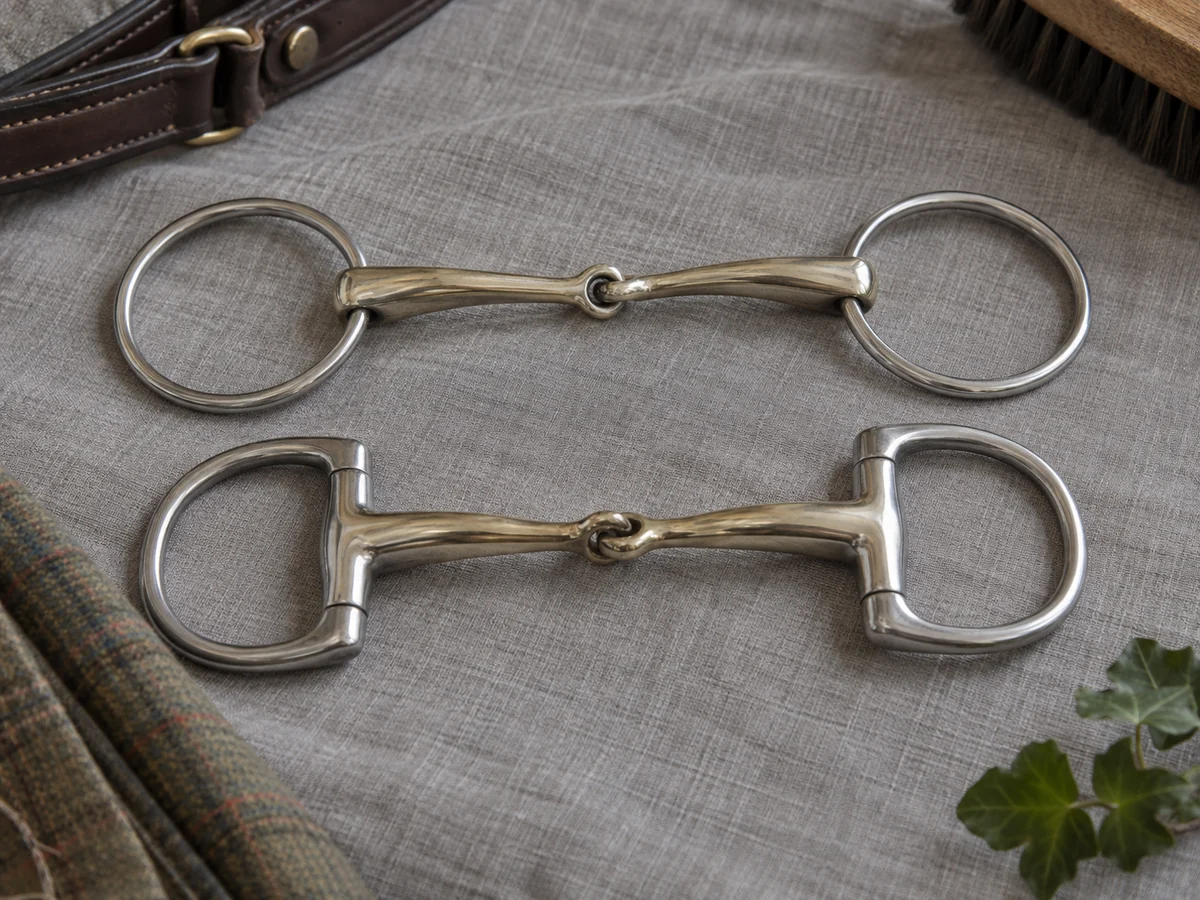
Separate two descriptions
The mouthpiece sits across the mouth; the cheeks are the parts at its sides. A bit can therefore be described by both its mouthpiece and its cheek design. Two bits may share a double-jointed mouthpiece yet have very different sides. When asking for advice or replacing equipment, give both descriptions and the exact model rather than saying only 'a snaffle'.
On a loose-ring design, the ring passes through an opening at the end of the mouthpiece and can move relative to it. A fixed-cheek design, such as an eggbutt or D-ring, has a different connection. This distinction is visible on the table, but it does not tell you everything about how the complete bit acts in a particular mouth.
Movement brings fitting questions
The relationship between the ring, mouthpiece and lips needs checking. Appropriate width cannot be reduced to one universal rule for all cheek types. Adding guards or changing the width without advice can alter the available space and arrangement. A competent bit fitter should consider the individual horse and explain why a particular fit is appropriate for the chosen design.
Some cheeks extend above or below the mouthpiece, and others have several attachment positions. These are not interchangeable decoration. Attachment location can change the action, and certain designs have specific requirements for additional components. Do not choose a different hole or ring simply because it looks convenient. Ask for an explanation and supervised fitting before using unfamiliar equipment.
Describe the whole product
When buying online, request clear photographs of both sides, the mouthpiece and any markings. A side view alone may hide a different centre link or an orientation mark. Record the make, model, mouthpiece thickness and stated width so that a future replacement can be identified accurately. Similar metal colour is not evidence that two bits are equivalent.
For daily inspection, rinse and clean as the manufacturer directs, then check moving joints and the areas beside the mouthpiece. Wear can be difficult to see beneath dried saliva. If movement has changed, edges are rough or a component looks distorted, stop using the bit pending advice. A ring that moves differently from its partner is worth investigating rather than explaining away as normal age.